 Posted by
 Comfort is one of the most misunderstood words in plus-size fashion.
Most brands think comfort means soft fabric or loose fit. But if you’ve ever worn a dress that felt okay for 10 minutes and unbearable after two hours, you already know the truth:
A dress isn’t comfortable unless it stays comfortable while your body moves, sits, eats, walks, and lives.
For curvy bodies, comfort isn’t about hiding shape. It’s about how a dress behaves on a real, three-dimensional body – with a bust, belly, hips, thighs, and natural movement.
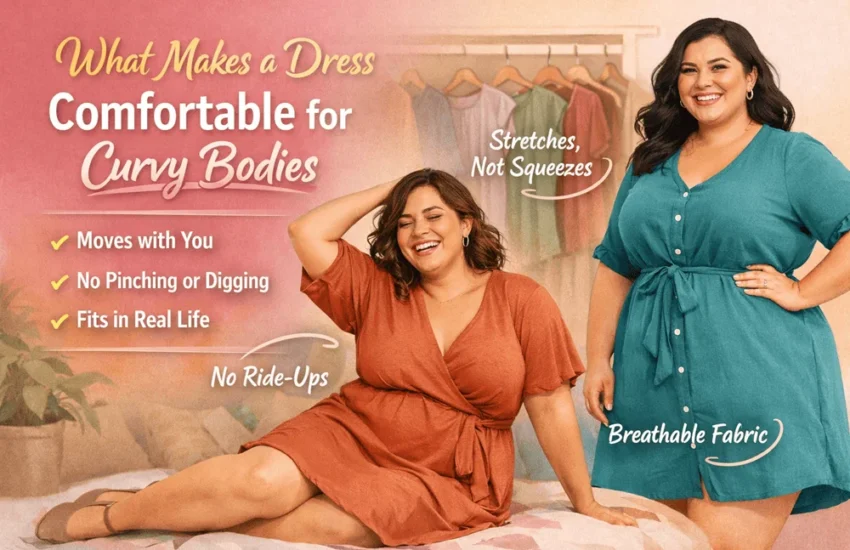
Let’s break down what actually makes a dress comfortable for curvy bodies beyond marketing words.
Comfort Is About Behavior, Not Just Feel
A dress can feel soft on the hanger and still be uncomfortable when worn.
True comfort answers questions like:
-
Does the dress pull when I sit?
-
Does it dig into my underarms?
-
Does it ride up when I walk?
-
Do I feel pressure after eating?
-
Am I constantly adjusting it?
If the answer is yes, the dress isn’t comfortable, even if the fabric feels nice.
1. Fabric That Works With Curves (Not Against Them)
Fabric choice is the foundation of comfort.
What matters most is not the fabric name, but how it behaves:
-
Does it stretch and recover?
-
Does it cling to sweat-prone areas?
-
Does it soften with movement or stiffen?
For curvy bodies:
-
Fabrics that drape naturally reduce friction
-
Breathable blends prevent overheating (especially important in Indian weather)
-
Poor-quality stretch that doesn’t recover leads to sagging, pressure, and discomfort
This is why some dresses feel worse as the day goes on, the fabric gives up before you do.
2. Proper Bust Accommodation (Not Just “Room”)
A tight bust affects the entire dress.
When the bust area is under-designed:
-
Necklines pull forward
-
Armholes dig in
-
Waist seams ride up
-
The dress feels restrictive everywhere
Comfortable dresses for curvy bodies:
-
Allow space for a fuller bust without stretching seams
-
Don’t rely on chest compression to “shape” the body
-
Balance bust space with waist and hip proportion
This is especially important for women with a fuller bust, comfort starts at the top.
3. Waist and Tummy Ease (Not Compression)
Comfort is not the same as control.
Many dresses marketed as “tummy-flattering” use:
-
Tight panels
-
Strong elastics
-
Heavy compression
These may look structured at first but become uncomfortable quickly especially when sitting or after meals.
Truly comfortable dresses:
-
Allow natural belly expansion
-
Use shaping through cut, not squeezing
-
Feel supportive without restricting breathing or digestion
If a dress makes you feel relief the moment you take it off, it was never comfortable.
4. Length That Supports Movement
Length plays a huge role in comfort, especially for curvy thighs and hips.
Common comfort killers:
-
Dresses riding up when walking
-
Fabric sticking between thighs
-
Constant adjusting when sitting or standing
Comfortable lengths:
-
Stay in place when you move
-
Don’t cling to inner thighs
-
Don’t twist or shift with body weight changes
This is why many curvy women feel more comfortable in well-designed midi or maxi lengths not because they “hide” anything, but because they move better.
5. Construction Details Most People Ignore
These small details decide whether a dress feels good or exhausting:
-
Seams: Poor grading creates pressure points
-
Lining: Cheap lining traps heat and restricts movement
-
Elastic quality: Weak elastic digs or rolls
-
Neckline weight: Heavy necklines pull the dress forward
-
Armholes: Too small = constant discomfort
Comfort isn’t accidental, it’s engineered.
Comfort in Real Life (Not Just in the Mirror)
A dress must work in real situations, not just while standing still.
Ask yourself:
-
Can I wear this for an 8-hour workday?
-
Can I sit, eat, and walk comfortably?
-
Will this survive heat, travel, and long events?
A comfortable dress supports your day, it doesn’t demand attention.
What Comfort Is Not (Important Myths)
Let’s clear this up:
-
❌ Comfort is not just loose clothing
-
❌ Comfort is not always stretchy fabric
-
❌ Comfort is not sizing up
-
❌ Comfort is not hiding your body
A well-designed dress can be fitted and comfortable at the same time.
How to Test Dress Comfort Before Buying
Use these quick checks (online or in-store):
-
Arm raise test – Does the dress pull?
-
Sit-and-stand test – Does it ride up?
-
Bust pull test – Are seams under tension?
-
Fabric recovery test – Does it bounce back?
-
Length behavior test – Does it shift when you move?
If a dress fails two or more tests, comfort won’t improve with time.
FAQs for
What makes a dress comfortable for curvy bodies?
A dress is comfortable for curvy bodies when it allows movement, accommodates bust and tummy space, uses breathable fabrics, and doesn’t create pressure points during sitting, walking, or long wear.
Is stretchy fabric always more comfortable for plus-size women?
No. Stretch without proper recovery or structure can cause sagging, pressure, and discomfort. Comfort depends on fabric behavior, not just stretch.
Why do dresses feel uncomfortable after a few hours?
Because poor fabric quality, tight bust areas, or restrictive waist construction cause friction, heat buildup, and pressure as the body moves.
Are loose dresses more comfortable than fitted ones?
Not always. Poorly cut loose dresses can twist, ride up, or feel bulky. Well-fitted dresses designed for curves often feel more comfortable.
How can I tell if a dress will be comfortable before buying?
Check fabric recovery, bust ease, armhole space, length movement, and whether the dress stays in place when sitting and walking.
Why Comfort Changes Everything
When a dress is truly comfortable:
-
You stop adjusting it
-
You move naturally
-
Confidence becomes automatic
Comfort isn’t about lowering standards, it’s about better design.
Curvy bodies don’t need to compromise on comfort. They need dresses made with intention.